Chongqing rewards visitors who venture beyond the postcard shots. Built into cliffs and hillsides at the convergence of two mighty rivers, this sprawling metropolis is a study in contrasts — ancient temples and Song-dynasty history coexist with cyberpunk skylines and cutting-edge architecture. Once China’s wartime capital during the Japanese invasion, Chongqing has transformed into a forward-looking megacity without losing the character that makes it endlessly fascinating.
With over 30 million residents spread across mountains and river valleys, Chongqing is less a single city and more a collection of distinct neighborhoods, each with its own personality, cuisine, and character. The Yuzhong peninsula, sandwiched between the Yangtze and Jialing rivers, remains the historic heart — a compact maze of steep streets, riverside promenades, and landmarks that have shaped the city’s identity. Beyond the central peninsula lie vast urban sprawls climbing hillsides, interconnected by an intricate metro system and countless cable cars.
What makes Chongqing truly unique is its uncompromising authenticity. Unlike some Chinese cities that have smoothed their edges for tourism, Chongqing remains unapologetically itself — a place where ancient traditions, wartime history, and modern ambition collide daily. Visitors often describe it as overwhelming at first, then magnetic.
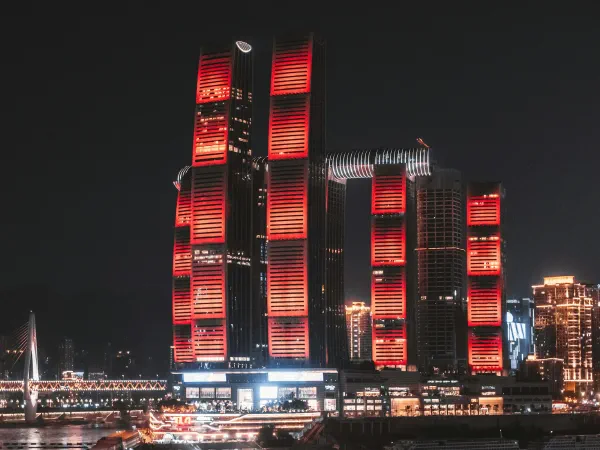
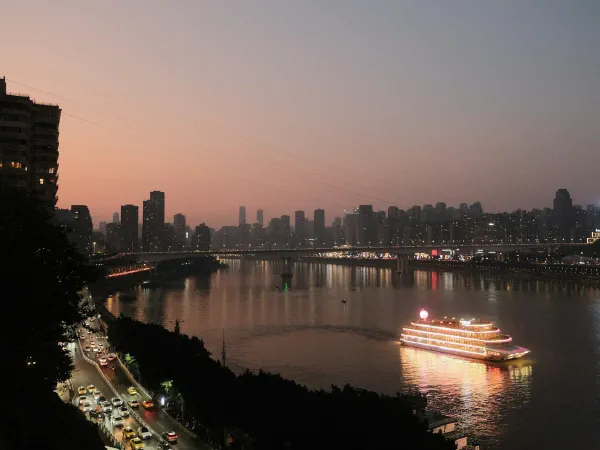
Chongqing’s reputation for spectacular night views is internationally renowned and absolutely justified. The city’s dramatic topography means buildings rise at impossible angles, stacked vertically up steep hillsides, creating a three-dimensional landscape of lights that cascades down toward the water in ways that confound the camera. From dusk onwards, the cityscape transforms into a glittering wonderland of neon signs, building lights, and street lamps reflecting off the rivers below.
The best way to experience this is from the water itself — the Two Rivers Night Cruise takes you slowly past illuminated landmarks as the Yangtze and Jialing rivers converge, a route celebrated as one of the “Twelve Scenic Views of Bayu” centuries before electricity was invented. The boats depart several times nightly and the journey becomes a meditation on the marriage of natural geography and human ambition.
From land, the Raffles City Exploration Deck offers unobstructed 360-degree views from 250 meters up, letting you see the scale of the city unfold in all directions. For a more intimate experience, Yikeshu Viewing Platform provides carefully framed skyline vistas paired with cocktails and a younger crowd. The city transforms even more dramatically during special events — particularly the Saturday Drone Show, when hundreds of synchronized drones paint intricate patterns and shapes across the sky above the Jiangbeizui district.
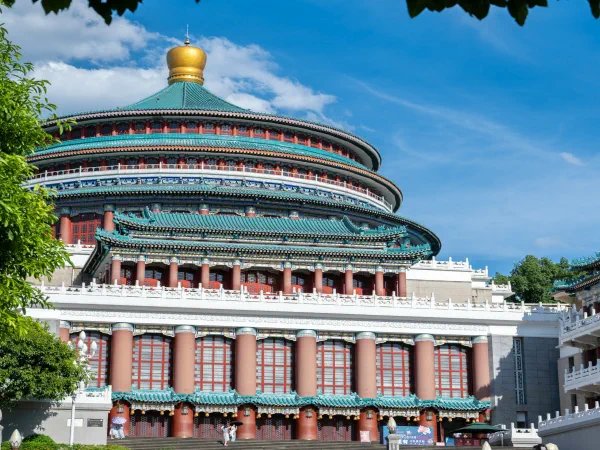
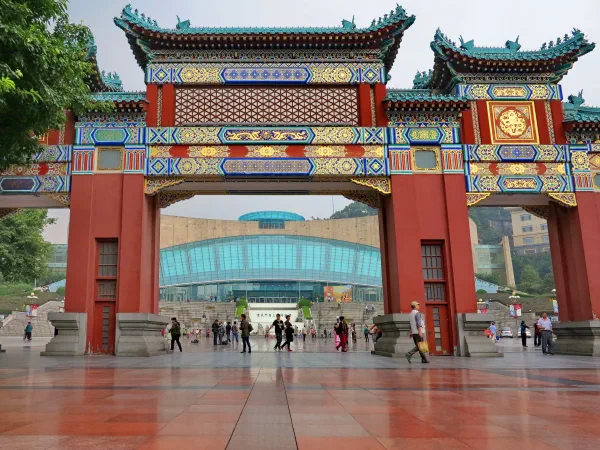
Chongqing’s architectural landscape tells layered stories of dynasties, wars, reconstruction, and audacious modernization. The People’s Assembly Hall stands as a masterpiece of mid-century design — a Ming-inspired palace complete with peacock-blue glazed tile roofs that has hosted thousands of cultural events, conferences, and performances since its completion in 1954. The craftsmanship remains extraordinary; the interior details rival anything built during the Qing dynasty.
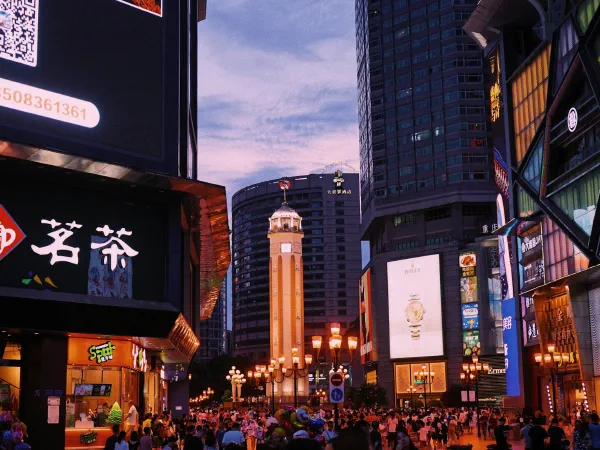
Dominating the old city skyline from Liberty Square, the People’s Liberation Monument rises with its distinctive hand-shaped silhouette, a symbol of the city’s revolutionary past and present. The surrounding plaza thrums with activity — street musicians, couples, families, and tourists all converge here as the sun sets.
For a more playful and contemporary take on modern architecture, the Liziba Station has become an Instagram sensation worldwide — a surreal building that’s simultaneously pierced and wrapped by a metro line, challenging every conventional notion of how structures should coexist with infrastructure. The engineers solved an impossible puzzle here, and the result is both functional and visually arresting.
The city’s artistic credentials extend to the striking red-and-black geometric lattice of the Art Museum, nicknamed the “chopstick building.” The design draws inspiration from ancient Han-dynasty construction techniques while serving as a pristine container for contemporary Chinese art. It’s a symbol of how Chongqing refuses to choose between past and future.
Despite its ultra-modern skyline and tech-forward economy, Chongqing remains deeply connected to its Buddhist and spiritual heritage. Luohan Temple, perched on a hilltop with panoramic city views, dates back over a thousand years and continues to function as an active temple, not merely a historical site. It houses a massive golden Buddha that draws both devout pilgrims and curious tourists seeking pockets of tranquility above the urban energy. The climb to reach it is steep but rewarded with views that remind you of Chongqing’s geography — a city built vertically.
For those willing to venture further, the Dazu Rock Carvings, a UNESCO World Heritage site about 90 minutes from the city center, represent five centuries of continuous Buddhist and Confucian artistry painstakingly carved directly into cliff faces. The artisans worked across generations, adding to and refining the sculptures. Standing before these carvings, you’re looking at spiritual practice made stone — a journey through faith that predates most of Chongqing’s current landmarks by centuries.
Chongqing’s role as China’s wartime capital during the Japanese invasion left indelible marks on the city’s memory and landscape. The Hongyan Revolutionary History Museum was a Communist Party safe house during the war, its rooms carefully restored to show how resistance was organized from these modest spaces. Walking through them offers glimpses into a pivotal moment in Chinese history, when Chongqing became the seat of government and a symbol of Chinese resilience.
The Museum of the June 5th Tunnel Tragedy documents a devastating WWII bombing raid that killed thousands seeking shelter in tunnel systems. It’s a haunting, necessary museum that serves as a sobering reminder of the city’s wartime suffering and the cost of resistance.
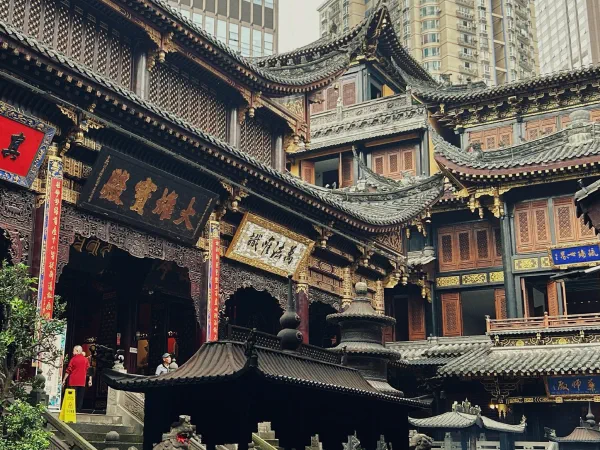
The Three Gorges Museum takes a longer historical view, showcasing 3,000 years of Yangtze River civilization through artifacts, pottery, and documents. Meanwhile, the Huguang Guild Hall tells the story of mass internal migration that reshaped the entire region — its four interconnected temples are decorated with elaborate wood carvings and stone reliefs that showcase the craftsmanship migrants brought with them from other provinces.
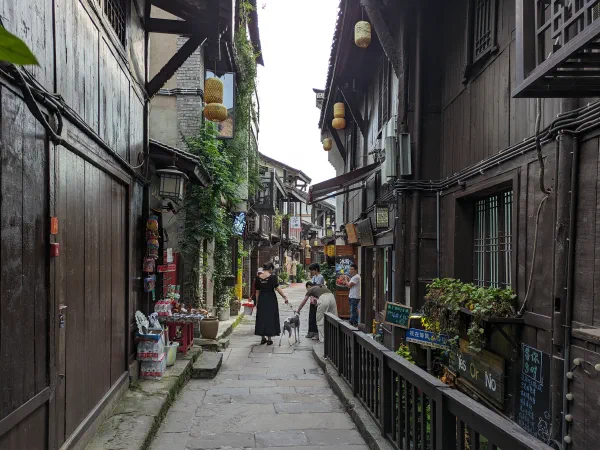
Getting lost in Chongqing’s old neighborhoods is half the adventure and entirely intentional — the street layouts date back centuries and were never designed for modern efficiency. Ciqikou Ancient Town preserves Ming and Qing dynasty architecture in an atmospheric riverside setting, its narrow lanes lined with traditional shops selling everything from herbal remedies to handicrafts, teahouses where locals play mahjong, and restaurants serving dishes unchanged for generations.
For an even more disorienting and rewarding experience, Shibati offers a labyrinth of medieval alleyways carved into cliffs where you can wander for hours without encountering the same street twice. Locals still live here; laundry hangs between buildings, and the smell of home cooking drifts from open windows. It’s tourism with a lived-in quality, not a theme park.
Tongyuan Gate, one of the original city gates, stands as a remnant of the walled town that protected Chongqing for centuries. Though the walls are gone, the gate remains, a threshold between the old city inside and the modern sprawl beyond.
No visit to Chongqing is complete without surrendering to its legendary food culture. Hao Chi Jie, the legendary food street, packs some of the city’s most authentic staples into one concentrated, aromatic stretch — suanlafen (hot and sour rice noodles), xiaomian (spicy broth with handmade noodles), chuan chuan skewers (Sichuan hot pot on sticks), and spicy duck neck that locals will tell you is better nowhere else on Earth. Most are eaten standing at counters or on tiny plastic stools, reflecting Chongqing’s no-nonsense approach to cuisine. Come hungry, bring cash, and prepare to sweat.
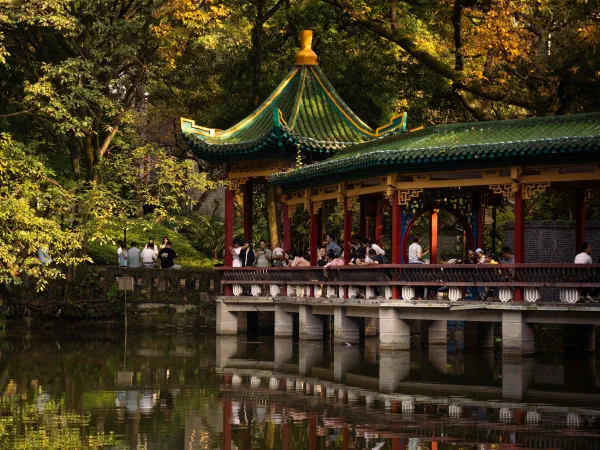
For nature lovers seeking green space, Eling Park sits atop the Yuzhong peninsula’s highest point, a classical Chinese garden with sweeping views over both converging rivers. The gardens feel centuries old even where they’re recent; the landscaping follows principles older than any standing building. Nanshan Botanical Garden, Chongqing’s largest green space, sprawls across 550 hillside hectares of themed gardens, native forest, and walking trails — a perfect escape from urban intensity when the city feels too overwhelming.
For wildlife enthusiasts, the Chengdu Research Base of Giant Panda, about 2 hours away by high-speed train, hosts over 150 pandas — roughly a quarter of all captive pandas globally. It’s one of the world’s most important conservation facilities and offers a glimpse into breeding programs that have brought pandas back from the edge of extinction.
Closer to home, the Chongqing Zoo brings wildlife within the city, featuring giant pandas, snow leopards, and over 250 animal species positioned on the hillside in naturalistic settings.
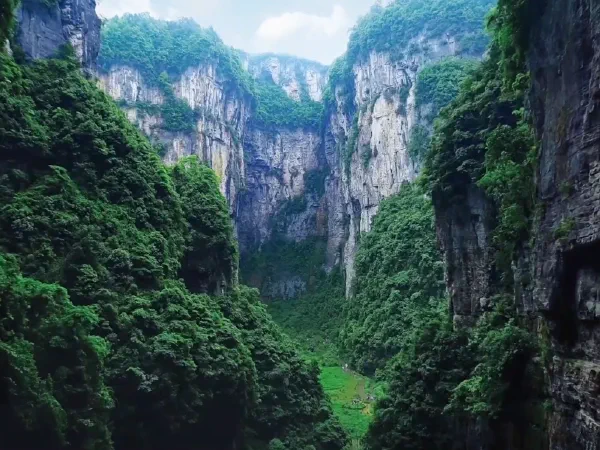
For those willing to venture beyond the city’s boundaries, the Wulong Karst National Geological Park showcases three colossal natural bridges carved by underground rivers over millions of years — a geological masterpiece about 90 minutes from the city center. Each bridge represents a different stage of erosion; walking beneath them gives perspective on geological time in ways that photographs cannot capture. The site is relatively undeveloped compared to other Chinese natural wonders, which adds to its authentic appeal.
The Yangtze River Cableway, built in 1987 as a daily commute for residents, has become a scenic attraction in its own right. The journey takes four minutes crossing the river in panoramic cabins above the water; it’s been nicknamed the “first aerial corridor on the Yangtze River” and offers views no ground-level vantage can replicate. It’s still used by some locals as functional transport, which adds to its character.
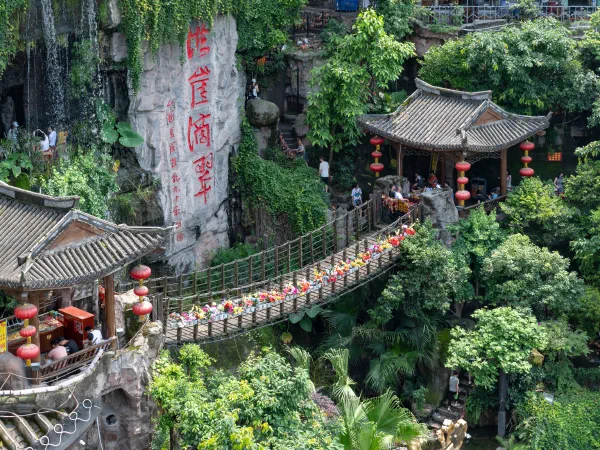
Hongyadong, a neon-soaked complex carved directly into ancient cliff caves, perfectly represents Chongqing’s ability to blend old and new without apology. By day it’s a historic riverside area with preserved stone architecture and narrow passages; by night it transforms into a glittering entertainment district with neon signs reflecting off the river. The dichotomy is the point — it’s not nostalgia, it’s living history with a soundtrack.
Firefly Harbor Cat Theme Park offers a more whimsical modern attraction — a riverside sanctuary housing hundreds of rescued cats in climate-controlled comfort. It’s become surprisingly popular with locals seeking a quiet afternoon away from the urban intensity, and the cats themselves are well-cared-for residents, not tourist props.
The Chongqing Science and Technology Museum showcases China’s scientific ambitions through over 400 interactive exhibits, a full-size IMAX cinema, and hands-on learning spaces that appeal genuinely to visitors of all ages — not just children. The exhibits change seasonally and often feature cutting-edge research happening in China’s tech centers.
Chongqing reveals itself best to those who linger and resist the urge to optimize. A week-long stay allows you to experience the riverside landmarks without rushing, navigate the old city’s maze-like streets without a map, enjoy multiple meals at the same street food stalls so vendors start recognizing you, and take several night cruises to see how the skyline changes with weather and season. The city’s rapidly expanding metro system covers the main attractions, though exploring by foot teaches you far more. Local knowledge — asking your hotel staff for recommendations, striking up conversations in teahouses, observing where locals eat — consistently leads to discoveries far better than any guidebook.
The best times to visit are spring (March-May) and autumn (September-November), when the humidity sits at tolerable levels and the city’s lights don’t have to compete with oppressive, exhausting heat. Summer brings crowds but also the famous drone shows and extended daylight for exploring. Winter offers clearer, colder skies ideal for skyline photography and long walks without sweating through your clothes.
Chongqing challenges first-time visitors with its sheer scale, disorienting topography, and relentless density — it does not present itself gently. But beneath the noise and neon lies a city of genuine complexity and character — one where you can breakfast at a temple older than nations, lunch at a street food stall cooking recipes unchanged for generations, and dinner on a boat watching the future unfold in lights across the water. That duality, that refusal to choose between past and future, is what makes Chongqing magnetic.