Photo by Aden So on Unsplash
鹅岭公园
Yuzhong
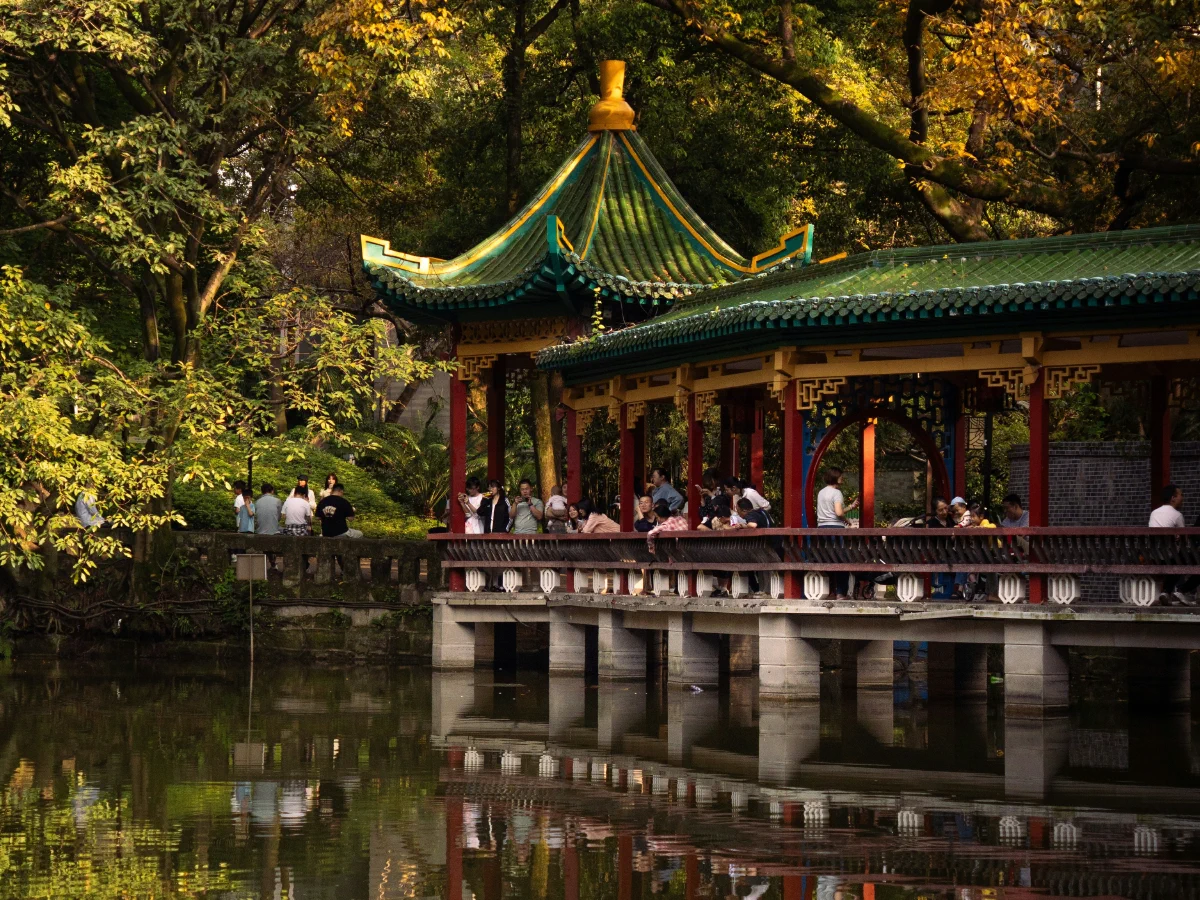
Sitting atop the highest point of the Yuzhong peninsula, at around 340–380 meters, Eling Park is one of Chongqing’s oldest and most atmospheric green spaces — a classical Chinese garden with sweeping views over both the Yangtze and Jialing rivers. It began life in the late Qing dynasty as a private villa garden, built around 1909 by Li Yaoting, a wealthy salt merchant and the first president of the Chongqing Chamber of Commerce, who named it Liyuan after being drawn to the hill’s natural beauty. The park was substantially restored and reopened to the public in 1958, taking its current name — Eling, meaning “Goose Ridge,” a nod to the narrow, steep shape of the hill it sits on.
Inside, winding stone paths connect a series of pavilions, terraces, and bridges in traditional Suzhou-garden style, including the hexagonal Feige (Flying) Pavilion, once used as a wartime residence, the arched Stone String Bridge, and a lotus pond stocked with koi. The park’s main draw for most visitors is Lansheng Tower (also called the Liangjiang Pavilion), a lookout tower offering a 360-degree panorama over the city and its two rivers — one of the better, less crowded skyline viewpoints in central Chongqing. The site also has historical weight beyond its garden design: during the wartime capital years, it hosted a number of prominent Republican-era figures, including Chiang Kai-shek.
Entry is free (aside from occasional special events, like the autumn chrysanthemum show, which may carry a small charge), and the park makes a peaceful, shaded break from the city below — particularly appealing in spring and autumn when the gardens are in bloom.