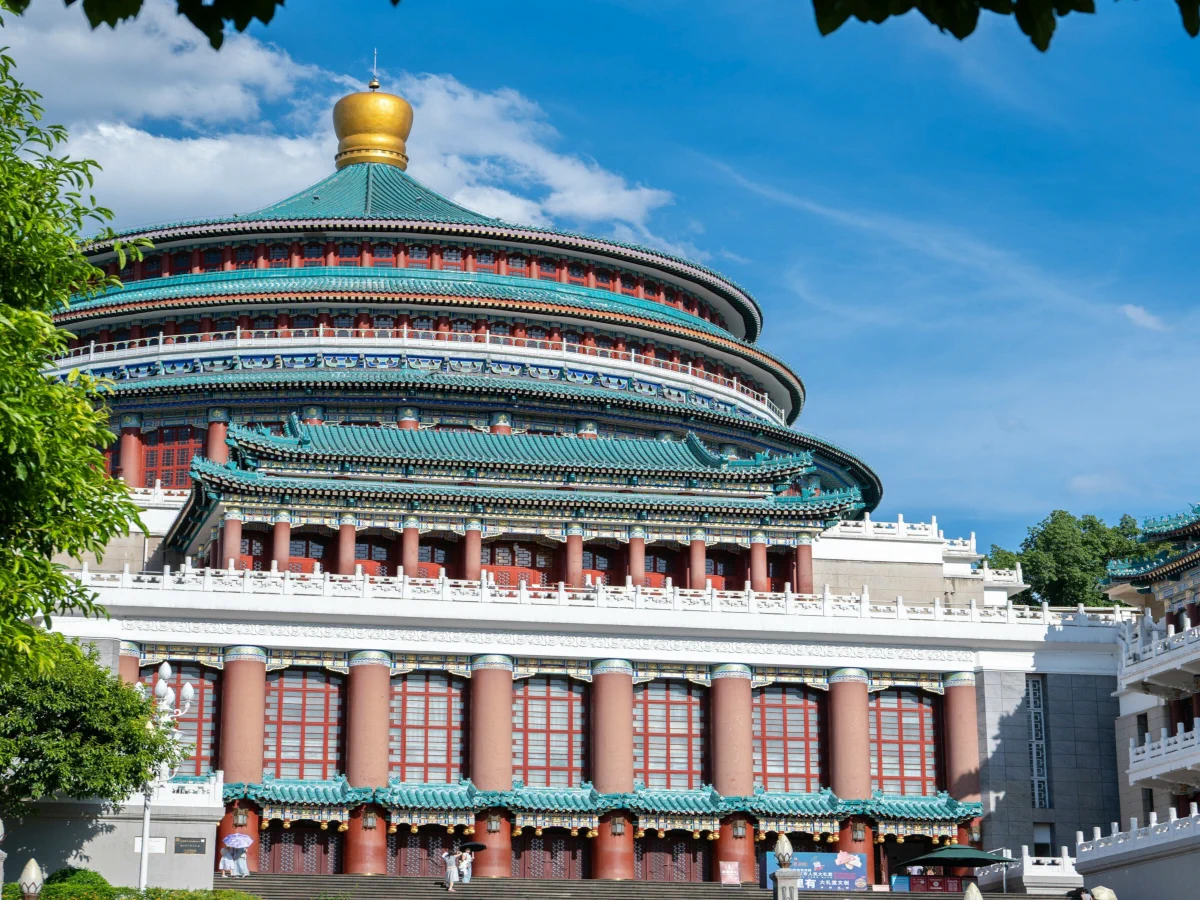
Photo by Will on Unsplash
重庆人民大礼堂
Yuzhong
The Chongqing People’s Assembly Hall (often called the Great Hall of the People) is one of the city’s most distinctive pieces of architecture: a sweeping, Ming-and-Qing-inspired palace complex crowned with peacock-blue glazed tile roofs and gold trim, built around a central domed hall modeled loosely on Beijing’s Temple of Heaven. Construction ran from 1951 to 1954 under the direction of architect Zhang Jiade, commissioned by regional leaders including Deng Xiaoping and Liu Bocheng during the early years of the People’s Republic, when Chongqing served as the seat of the Southwest Military and Political Committee.
The complex covers 66,000 square meters and centers on a five-story, 55-meter-high main hall capable of seating over 4,000 people for large assemblies and performances — it’s still a working venue for concerts and events today, so opening hours for general visitors vary depending on scheduling. In 1987, the building was ranked second among 43 significant post-1949 Chinese structures profiled in a major British architectural history, and it has been designated a national key cultural relic.
Facing the hall is People’s Square, created in 1997 alongside Chongqing’s establishment as a municipality directly under the central government. It’s a large, open public plaza — popular for evening strolls, group dancing, and simply people-watching — with the domed Three Gorges Museum standing directly opposite the Assembly Hall, making this one of the more efficient stops in the city for combining architecture, history, and local life in one visit.