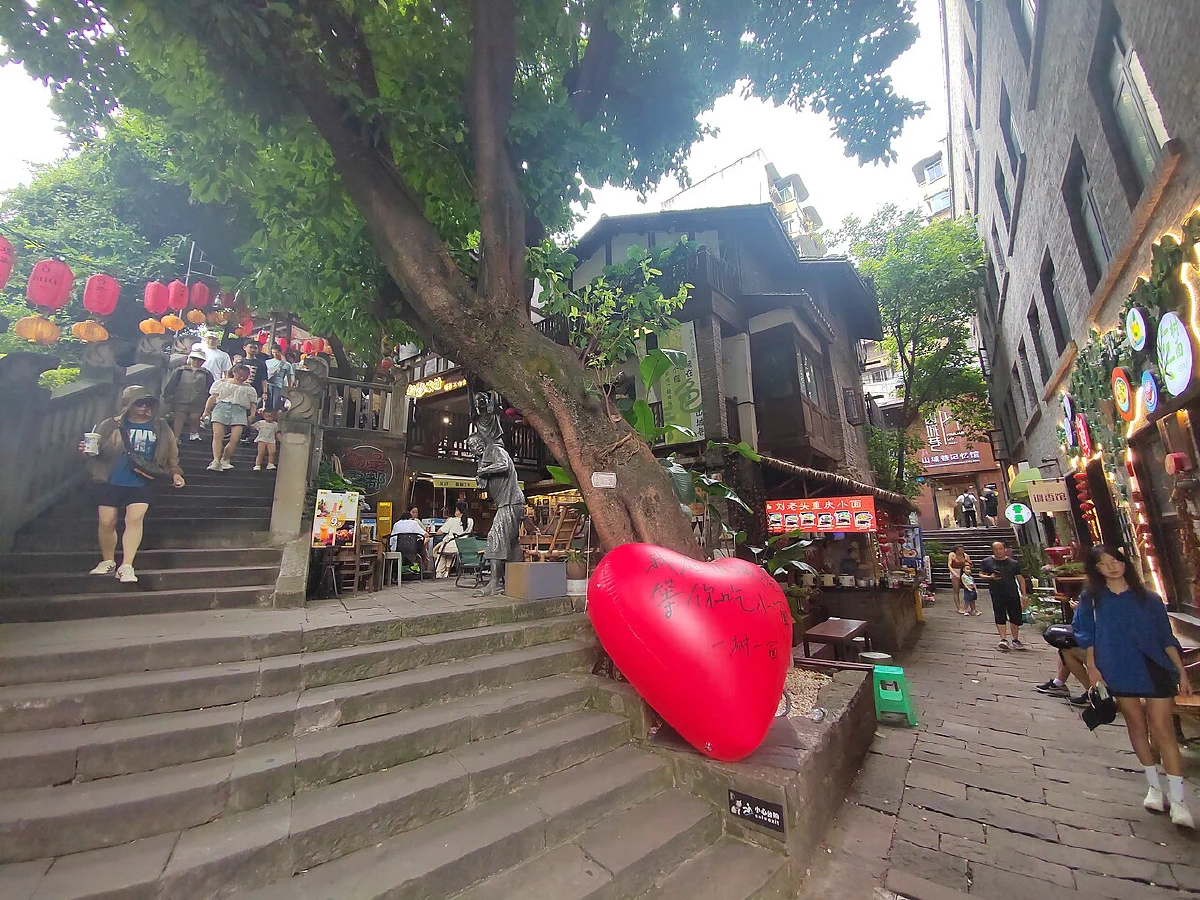
Photo by HoweyYuan, licensed under CC BY-SA 4.0
山城步道
Yuzhong
Shancheng Alley is the anchor point of Chongqing’s “Third Trail” (第三步道), a roughly 1.7-kilometer stepped walkway in Yuzhong District that stitches together the city’s upper and lower old town across a 79.5-meter change in elevation — one of around 60 planned “mountain city trails” (山城步道) across central Chongqing, and among the most historically rich.
The alley itself was originally named Tiandeng Xiang, or “Lantern Alley,” after French missionaries hung lanterns along it in 1900 to light the way for passersby; it took its current name, Shancheng Xiang, in 1972. Its history stretches back further still, to the Ming and Qing dynasties, and during Chongqing’s era as a treaty port the area became a favored residential district for its proximity to the foreign consular quarter, later housing senior Nationalist military officers during the Second Sino-Japanese War.
Walking the trail from its entrance near Zhongxing Road, visitors pass Tongyuan Gate (one of the old city’s fortified gates), the ruins of a French Sisters of Charity hall, the historic Houlu mansion, a dramatic suspended glass skywalk cut into the hillside, the Puti Jin’gang Pagoda, Kangjian Tang (a wartime auditorium), and the former Nationalist government Legislative and Judicial Yuan building, now part of Chongqing Municipal Zhongshan Hospital. Along the way, the neighborhood preserves traditional Ba-Yu hillside architecture largely unchanged: stilted diaojiaolou houses built out over the slope, old stone gateways, modest wartime-era “resistance houses,” and a scattering of Shanghai-style stone-fronted buildings from the treaty-port years.
The trail is one of Chongqing’s most photographed spots for capturing the contrast between the city’s old stepped alleyways and the high-rise skyline above, and it’s especially popular around sunset, when the terraces along the route open up views over the surrounding rooftops toward the river.